
By Andrew Boltz · July 30, 2026
Rome or Florence: prices checked against official sources on July 30, 2026. Transit fares for both cities re-checked September 2, 2026.
Rome or Florence? Somebody is going to tell you that Rome is the grand one and Florence is the pretty one, and that you should pick based on whether you prefer ruins or paintings.
That is not useless, but it is not a decision.
So here is the first surprise. For this exact three-day trip, Florence comes out more expensive. Not by a little.
Heads up: some of the links on this page are affiliate links. If you book or buy through one, I may earn a small commission and you pay exactly the same price. I only list things I would use myself. More in the full affiliate disclosure.
I compared three things: average hotel rates, official adult attraction prices, and public transport fares. Not meals, not flights, not airport transfers. Restaurant costs swing too wildly by neighbourhood to average honestly, so I left them out rather than invent a number.
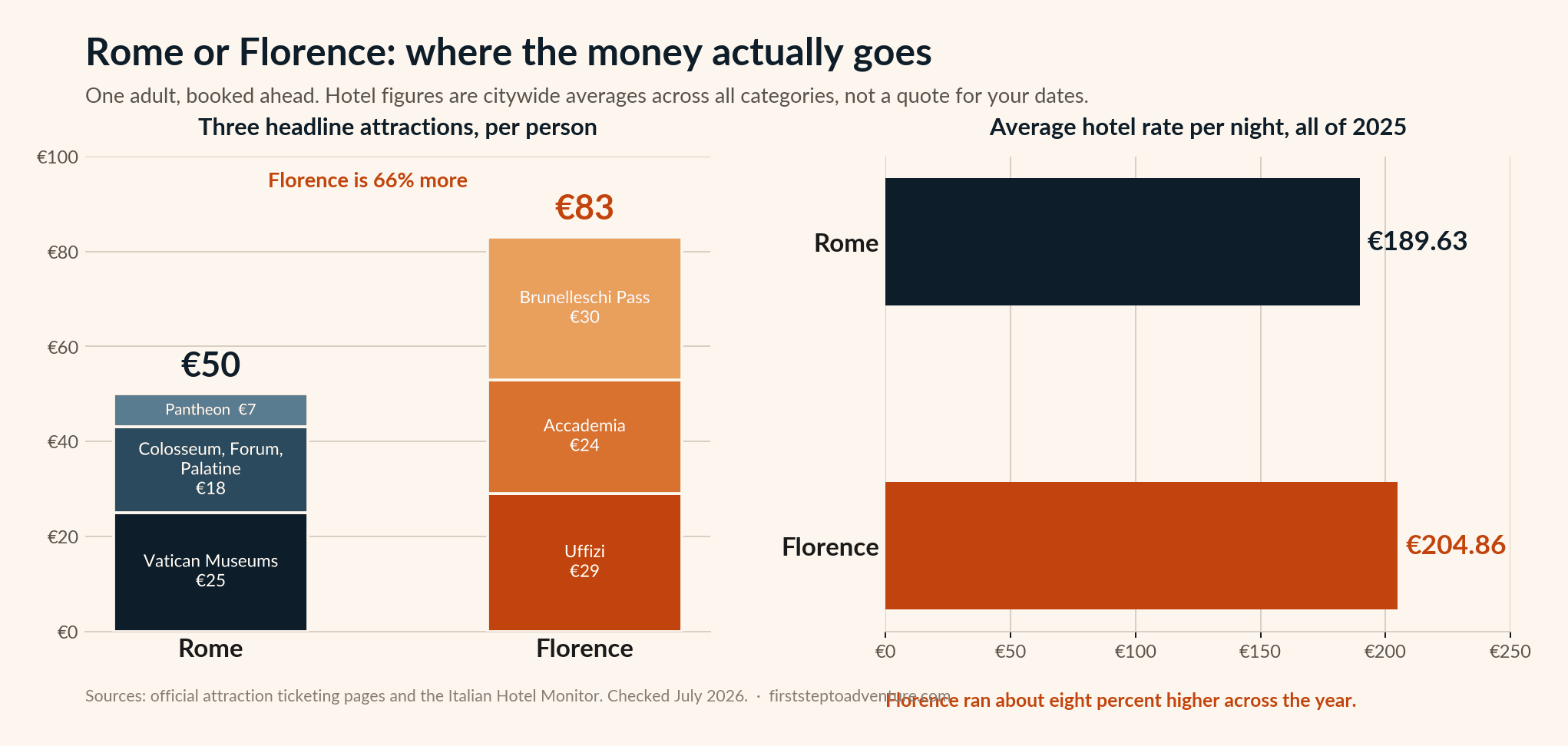
Hotels. Across all of 2025, the average daily hotel rate in Florence was €204.86 against Rome’s €189.63. For the first quarter of 2026, Florence was €173.18 and Rome €160.29. Florence ran about eight percent higher in both readings.
That figure is citywide average daily rate across all hotel categories, luxury included. It is not a quote for an equivalent 3-star room on your dates. If you want the real number for your dates, the fastest check is to pull both cities up side by side: current Rome hotel rates and current Florence hotel rates. The eight percent gap tends to hold, but your dates decide it.
Attractions. Three headline purchases in each city, adult, advance-booked:
| Rome | Florence | |
|---|---|---|
| Vatican Museums €25 | Uffizi €29 | |
| Colosseum, Forum, Palatine €18 | Accademia €24 | |
| Pantheon €7 | Brunelleschi Pass €30 | |
| Total | €50 | €83 |
Florence is about 66 percent more for those three purchases. The Accademia figure is its €20 admission plus the €4 booking fee, and note that it raised prices on February 1, so a lot of what you will read still says €16.
Worth being straight about the method too. The Brunelleschi Pass covers five sites across three days while the Pantheon is one building, so these are three comparable purchases, not three comparable attractions.
If you want the wider picture on what Italy started charging for, I went through it attraction by attraction in what costs more in Italy in 2026.
Put together, a couple doing this exact three-night trip is looking at roughly €105 more in Florence before a single meal. That is €66 on the three attractions for two people, plus about €39 to €46 across three hotel nights.
That is an illustrative comparison, not a quote. What it supports is narrow and specific: Florence costs more on hotels and on headline tickets. It does not prove Florence is dearer across every accommodation type, season and travel style.
Tourist tax is close enough to ignore. Both cities charge per person per night by hotel category, and the published rates sit within about fifty cents of each other at the 3-star and 4-star level. Rome charges for up to ten nights, Florence for up to seven. For a three-night stay the difference is a few euros. Do not let it decide anything.
Both cities, already mapped
However this lands for you, the three days still have to be built. Both guides lay out the full three days, with the tickets worth booking before you leave home.
Rome 3-Day Itinerary Florence 3-Day Itinerary
Instant download.
Rome’s UNESCO property covers about 1,469 hectares, of which the historic centre component is roughly 1,431. Florence’s property is 532 hectares. Rome’s is around 2.7 times larger.
That gives you a feel for how much more spread out Rome is, though a heritage boundary is not an itinerary. The practical version is simpler. Florence’s headline sights cluster tightly enough that walking between them is the default. Rome’s do not, so you will use buses and you will lose some of the day to getting places.
For three days that matters. Florence fits more neatly into the time. Rome forces harder choices about what you skip.
Rome. A single ticket is €1.50 and runs 100 minutes, covering transfers inside that window. The 72-hour pass is €22, which does not beat singles until your fifteenth ticket. For most three-day visitors, singles or contactless tap-and-go work out better. ATAC’s contactless option also applies a best-fare cap after repeated use in 24 hours.
Florence. A single costs €2.00 and the ten-ride carnet is €18.20, both up from €1.70 and €15.50 on August 1, 2026. You cannot buy from a tram driver, though contactless on-board payment is available, and buying on board from a bus driver costs €3.00, well above the machine price. There is no multi-day tourist pass here, so do not go hunting for one.
This deserves more care than the usual advice gives it, because “hard to walk” covers four different problems.
Step-free transit. Rome’s metro Line A has four stations with no lift: Spagna, Barberini, Repubblica and Vittorio Emanuele. Spagna serves the Spanish Steps and Barberini serves the Trevi area, so the gap lands right where visitors go. ATAC’s bus fleet is ramp-equipped, but a ramp on the vehicle does not guarantee an accessible stop or clear pavement at the other end. Check specific routes rather than writing off the metro.
Limited walking stamina. Florence’s compactness is the bigger advantage here. Shorter distances beat a larger city with better bus coverage.
Stairs. Florence’s Dome is 463 steps with no lift and it is entirely optional. Rome has cobbles, hills and large archaeological sites you cannot shortcut.
Standing in queues. Both cities. Timed tickets help in both.
There is no single winner. Match the city to your actual constraint.
Florence usually runs hotter on summer afternoons. Using 1991 to 2020 climate normals, July average highs come out around 32 °C in Florence against about 31 °C in Rome, with August similar.
Florence sits inland in a valley with no sea to moderate it. Rome gets some relief from being nearer the coast. The gap is roughly a degree on the averages, which sounds small and does not feel small at three in the afternoon in August.
If you are heat-sensitive and travelling in high summer, that is a genuine point for Rome. And it is one more reason to think hard about 463 steps.
Rome’s constraint is the Colosseum. The official park opens ticket sales 30 days before the visit date. That is a short runway and it is not a rumour, it is published policy. A trip planned in January cannot lock Colosseum tickets until a month out.
Florence’s constraint is the Dome. The time slot is fixed at purchase and cannot be changed or cancelled. Passes carry your name and you need ID.
And the Uffizi reverses the usual pricing logic. It is €25 at the door and €29 booked in advance. Booking ahead costs you four euros more.
Better still, there is a ticket almost nobody buys. A Friday evening ticket covering the Uffizi and the Vasari Corridor is €20 on the day, or €24 booked ahead. That is cheaper than a plain Uffizi ticket, and the Corridor normally takes that combination to €43. If your three days can include a Friday evening, it is the best-value ticket in either city.
Florence also sells a PassePartout at €40 covering the Uffizi, Pitti and Boboli across five consecutive days. On a three-night trip that only pays off if you are doing all three, but it changes the basket maths if you are.
Buy every one of these from the official ticketing site. Resale markups buy you nothing here.
Neither city requires that €50 or €83. Rome’s fountains, piazzas and monument exteriors cost nothing, and Florence’s cathedral nave at ground level is free and needs no ticket at all, even though the Dome climb is not. You can have a very good three days in either city on far fewer paid entries than my comparison assumes.
Florence has the stronger selection, but be honest about what a day trip costs you when you only have three days.
From Florence: Bologna is about 40 minutes, though that is the high-speed service, so it needs a booked ticket at a fare that moves with demand rather than a turn-up regional. Pisa is about an hour at €9.30, Lucca around 80 minutes at €8.40, Siena about 90 minutes at €10.20, all on flexible regional services.
From Rome: Ostia Antica, Tivoli and Frascati are all good and the reach is shorter.
At 80 to 90 minutes each way, none of these is “an afternoon out.” Add station time and it is half a day minimum. On a three-day trip, a day trip means giving up a city day. Only do it if the day trip is part of why you chose Florence.
Rome fits you if: the budget is tighter, you are travelling in high summer and heat matters, ancient history is the point, or you have done Italy before and want the version with more layers.
Florence fits you if: three days is all you have and you want to spend them looking at things rather than reaching them, Renaissance art is the reason you are going, you want short walks between sights, or you are willing to pay more per day for a denser trip.
The decision rule underneath all of it: Florence gives you a denser, more contained trip. Rome gives you more layers but demands more time.
Rome and Florence are about 90 minutes apart with 32 Italo services a day and fares from around €14.90 when booked ahead. The train is easy. Fitting a satisfying visit to either city into one day is the hard part, because round-trip rail time alone is close to three hours before you have reached a single sight.
If you are splitting the stay, book the train the moment your dates are fixed. The cheap advance fares go first and the walk-up price is a different animal. Check Rome to Florence train times and fares.
Once you have picked, where to stay in Rome and where to stay in Florence rank the neighbourhoods for each city, and when to visit Florence covers the months that change the price.
My 3-day guides do the part that eats your evenings: the route that actually works, the booking windows, what to skip, and where to eat that is not a photo menu near a monument.
The whole library is here.
Rome 3-Day Guide · Florence 3-Day Guide
Still deciding? Venice · Milan · Naples · Athens · Istanbul
Bundles: Rome + Naples · Venice + Milan · Athens + Istanbul
Hotel figures are citywide average daily rates from the Italian Hotel Monitor. Attraction prices are official adult rates. Florence bus fares rose on August 1, 2026 and the figures above are the current ones. Airfare, meals and airport transfers are excluded. Some links on this site are affiliate links, which cost you nothing and keep the lights on here.
Join the Adventure
No spam. Unsubscribe any time. One email at a time.